What Happens to unprocessed feelings?
There is something I often find myself wondering.
What happens to feelings that have nowhere to go?
Not the feelings we talk about with friends, write about in journals, cry through or work through in therapy.
The other ones.
The frustrations we swallow.
The worries we push aside.
The grief we keep ourselves too busy to feel.
The anger we tell ourselves we shouldn't have.
Most of us were never taught what to do with these feelings. We simply learned to carry them.
And so I sometimes wonder whether emotions are a little like rubbish.
Not because they are unwanted or dirty, but because they need somewhere to go.
If we don't deal with our rubbish, it doesn't magically disappear.
It piles up.
As adults, we often become remarkably skilled at functioning while carrying emotional weight.
We go to work.
Make packed lunches.
Answer emails.
Pay bills.
Take children to football practice.
From the outside, everything can appear perfectly fine.
Yet beneath the surface there may be exhaustion, resentment, sadness, anxiety or loneliness that has never been acknowledged.
The problem is that children are often far more aware of this than we realise.
Children do not simply listen to our words.
They notice our tension.
They notice our tone.
They notice when we are emotionally absent, even when we are physically present.
They learn about feelings not only through what we teach them, but through what we model.
A parent who never cries may unintentionally teach that sadness should be hidden.
A teacher who becomes overwhelmed by frustration may communicate that anger is frightening.
A carer who never rests may send the message that needs should be ignored.
None of this makes us bad parents, teachers or professionals.
It makes us human.
Yet it reminds us that children are always learning about emotions, even when nobody is talking about them.
I often wonder whether animals understand something that humans may have forgotten.
Watch a horse after a sudden fright. Once the danger has passed, it may shake, snort, move around, reconnect with its herd, gradually settle and graze.
Watch a dog after an unsettling encounter and you may see something similar.
There seems to be an instinctive understanding that the body needs somewhere for the experience to go.
Humans, on the other hand, are often praised for doing the opposite.
We stay professional.
We stay productive.
We carry on.
Sometimes we become so good at carrying our feelings that we forget we are carrying them at all.
Yet feelings do not disappear simply because they are ignored.
Perhaps this is one reason why movement, exercise, creativity, dancing, walking, gardening and time in nature can feel so restorative. They allow something that has become stuck to move again.
Like children, and perhaps like animals, feelings often find another way to speak.
This is perhaps why children's feelings so often emerge in ways that can seem confusing to adults.
A child may become controlling.
Another may withdraw.
Some become angry.
Others become clingy.
Some develop stomach aches.
Some struggle to sleep.
And some seem unable to stop moving.
We often ask children to explain these behaviours.
"Why did you do that?"
"What's wrong?"
"How are you feeling?"
Yet many children genuinely do not know.
The part of the brain responsible for putting feelings into words is still developing.
So children frequently communicate through something else.
Play.
For many children, play is where feelings go when words cannot reach them.
The child repeatedly crashing toy cars.
The child burying figures in the sand.
The child acting out battles between superheroes.
The child endlessly building and destroying towers.
To adults, it may simply look like play.
To the child, it may be something much more important.
Play allows feelings to be explored at a safe distance.
A frightening feeling can become a dragon.
A loss can become a disappearing character.
A sense of helplessness can become a superhero battle replayed again and again until something begins to feel manageable.
The psychoanalyst Donald Winnicott described play as the place where growth happens. Modern research continues to support what parents, teachers and therapists have long observed: play is linked to emotional regulation, resilience, social development and wellbeing.
Far from being a break from learning, play may be one of the primary ways children learn about themselves and the world around them.
Yet today's children are growing up in a very different world.
Many spend less time outdoors than previous generations.
Opportunities for unstructured play have declined.
Screens increasingly occupy spaces once filled by dens, bikes, climbing trees and neighbourhood adventures.
Technology has brought enormous benefits, but I sometimes wonder what happens when children's natural outlet for processing emotions becomes increasingly restricted.
If play is one of the places where feelings go, what happens when there is less space for play?
This becomes particularly important when we think about children who communicate differently.
Children who are autistic.
Children with intellectual disabilities.
Children who are minimally or non-speaking
Children whose feelings may not easily translate into spoken language.
For these children, emotional expression may look very different.
It may be found in movement.
In sensory play.
In repetition.
In rhythm.
In objects.
In silence.
In returning to the same activity over and over again.
To an observer, these behaviours can sometimes appear meaningless or repetitive.
But what if they are serving an emotional purpose?
What if they are helping the child regulate, organise, communicate or process experiences that are difficult to express through words?
When language is limited, the body often becomes the storyteller.
The challenge is that adults can sometimes become so focused on communication as speech that we overlook communication itself.
We wait for words while a child is already telling us everything we need to know.
Just not in the way we expected.
Perhaps this is one of the reasons I continue to be drawn to relational psychotherapy.
Because beneath every behaviour, every repeated game, every silence and every outburst sits a simple question:
"What am I supposed to do with this feeling?"
Children ask it.
Adults ask it too.
The difference is that adults often have more socially acceptable ways of hiding the question.
Maybe the real task is not learning how to get rid of difficult feelings.
Maybe it is creating spaces where they can safely exist.
A conversation.
A walk.
A therapy room.
A football pitch.
A horse.
A paintbrush.
A trusted person willing to sit alongside us while we work things out.
Because feelings do not disappear simply because we ignore them.
They always find somewhere to go.
The question is whether we notice where they end up.
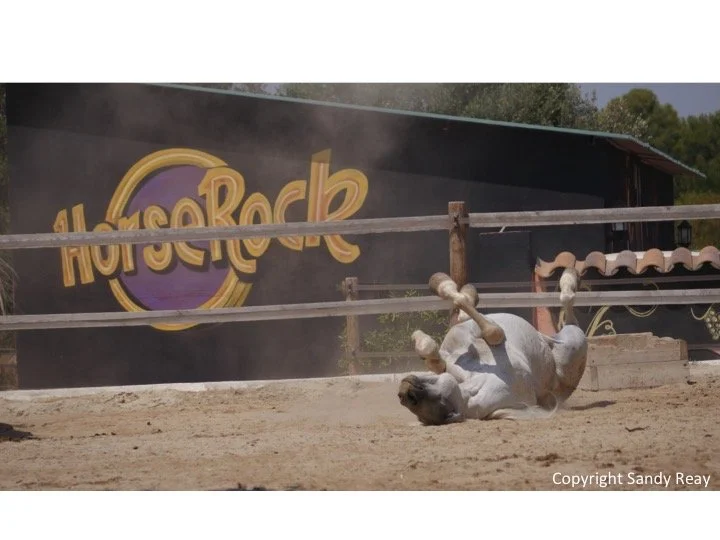
The Art of Play - Image c/o Sandy Reay